
Run Form Optimization
What You'll Learn in this Resource
➤ How to immediately decrease pain while running
➤ How to decrease your risk of developing running-related ankle, knee, hip, and low back arthritis
➤ How to improve your run performance
Introduction
Proper run form can be debated for hours and, ultimately, is dependent on your exact body dimensions.
That being said, there's one core principle of running form that's consistent across all body types in its ability to reduce pain, reduce risk of developing arthritis, and improve run performance.
That principle is landing with your foot as close to under your hips as possible.
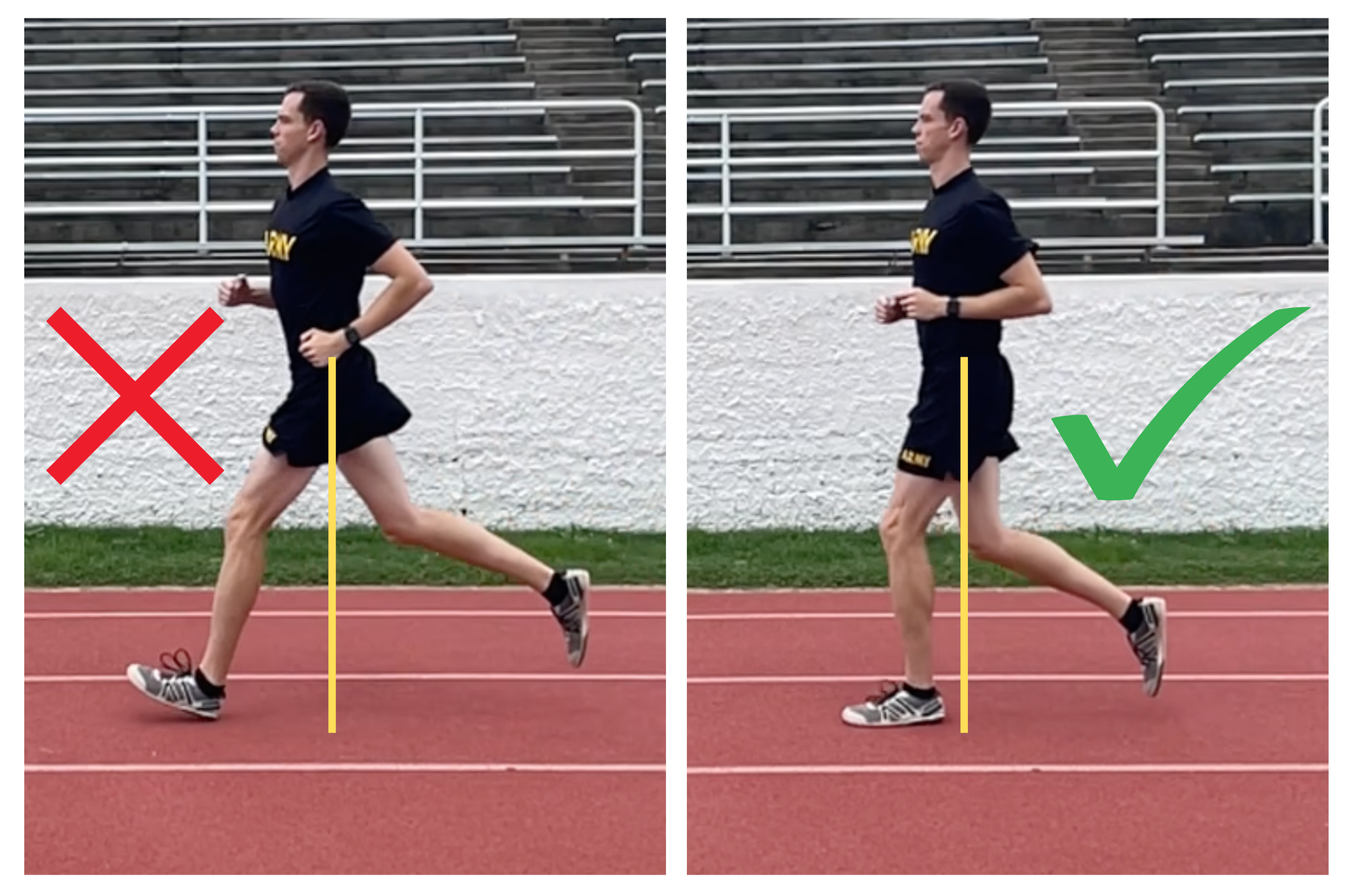
Landing with your foot too far in front of your hips causes a braking effect that increases the load on your ankles, knees, hips, and low back. This braking effect also makes you spend more energy when running, which worsens your run time.
Landing with your foot too far in front of your hips is also called "over-striding".
Here's the two solutions:
1) Increase cadence
2) Fall forward at the hips
Increase Cadence
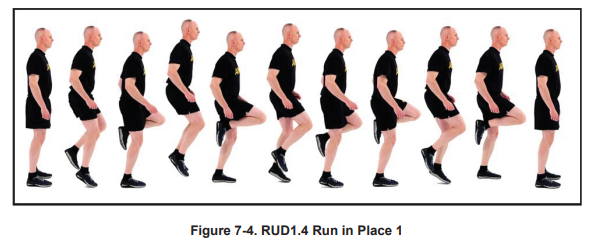
Cadence means number of steps taken per minute. It does not mean pace or how fast you run.
Cadence is inversely correlated with stride length. A low cadence (low number of steps taken per minute) = long strides. A high cadence (high number of steps taken per minute) = short strides.
The shorter your stride, the easier it is for your foot to land under your hips.
When optimizing run form, we focus on cadence instead of stride length because cadence is an easily measured number that a runner can change in the moment without video feedback.
Measuring Cadence
To measure your normal cadence, simply count how many steps you take in a 10 second time period and multiply by 6. That will give you the number of steps you take in one minute. You should get a number between 120-200 (if you don't, you're probably measuring wrong).
Here's some things to consider when testing:
➤ Make sure to count each step, both left and right.
➤ When performing cadence tests, use the pace you perform the majority of your mileage at. For example, if most of your jogs are at a 9 min/mile pace, do your cadence test at that pace.
➤ Make sure you take the 10 second measurement while you're already running, not as you step off.
The ideal cadence depends on your height, but generally ranges from 170-190 steps per minute.
For most people, 180 steps per minute is a good goal.
Just note if you're shorter than the average male you may benefit from increasing your cadence to the 190 range and if you're taller than the average male you may not be able to reasonably increase your cadence past 170.
Here's a couple tips to consider when working on increasing your cadence:
➤ Use a metronome until your higher cadence feels natural. I recommend the app Soundbrenner because it's free and it allows you to play the metronome audio and listen to your own music at the same time.
➤ Only increase your cadence by 5-10 steps per minute at a time. If you currently run at a cadence of 140, going straight to 180 will be too awkward. Instead, use a cadence of 145-150 until it feels natural, then progress.
Fall Forward at the Hips
In addition to increasing cadence, falling forward at the hips will also help correct over-striding.
Falling forward at the hips is particularly important if you're looking to improve your run time. To understand why, let's consider the two forces that enable you to move forward when running:
1) Muscular force (you "pushing" to go forward)
2) Gravitational force (gravity "pulling" you forward, which is dictated by your center of mass)
Here's an example of each type of force:
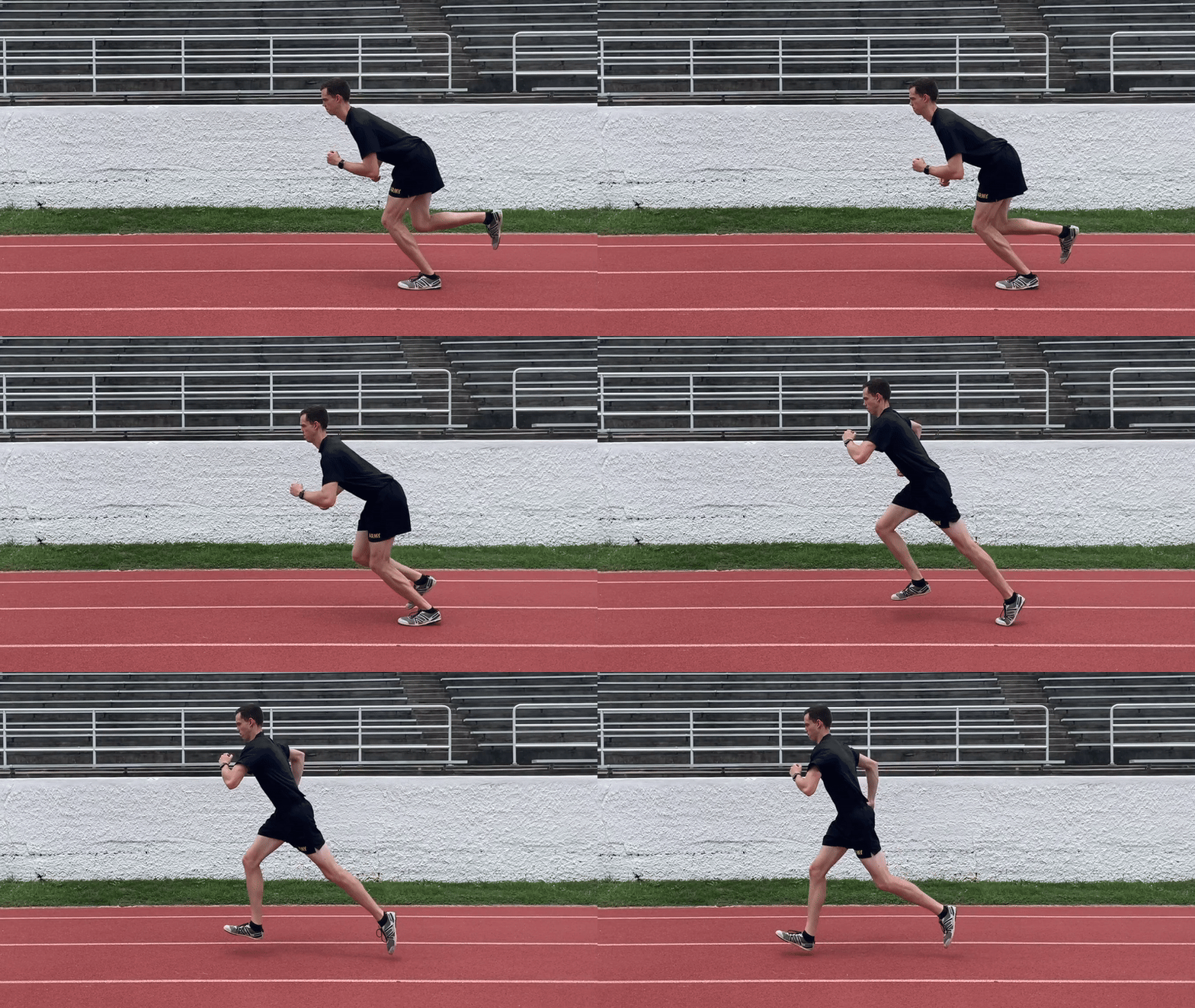
1) Muscular force = high energy usage
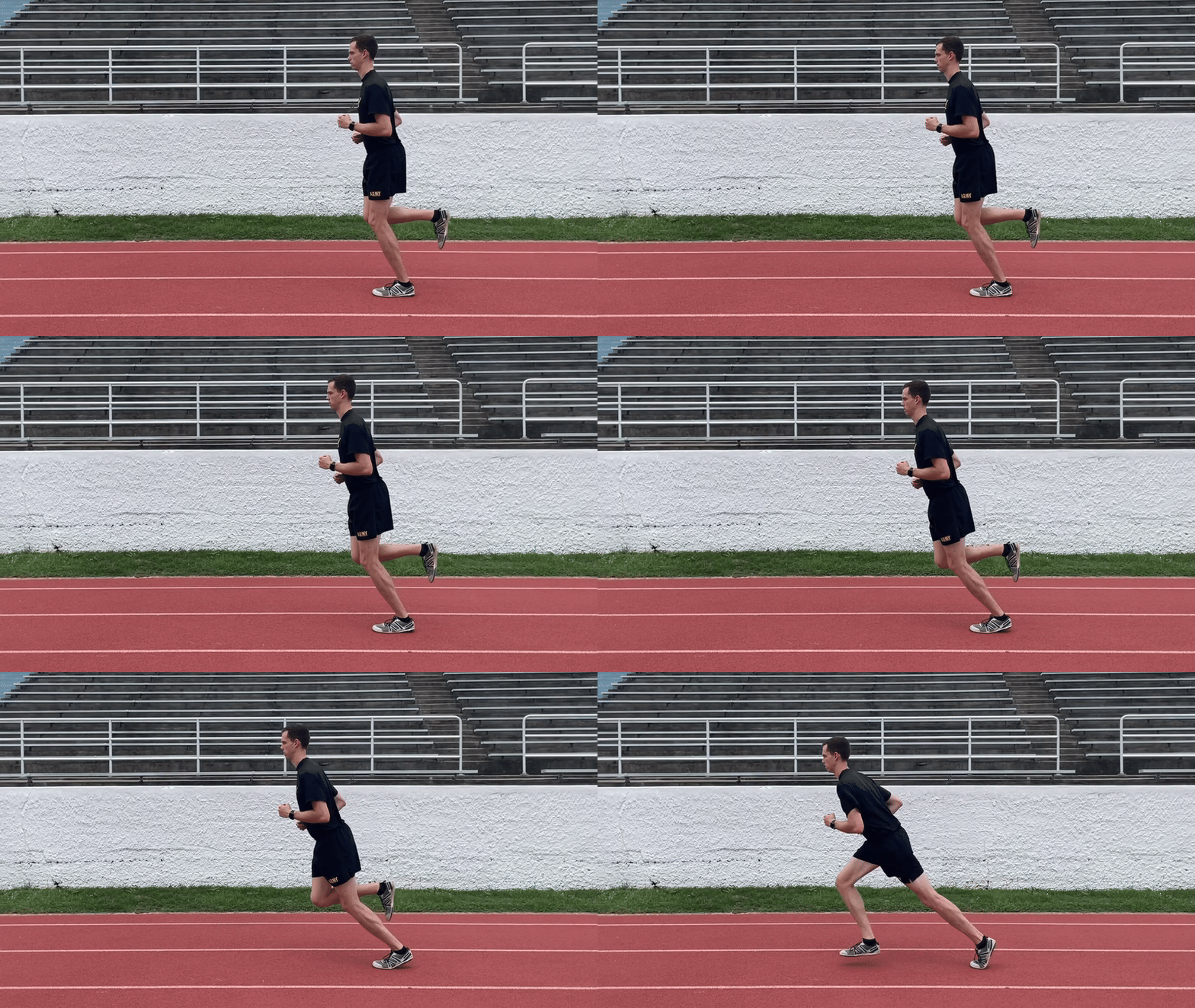
2) Gravitational force = low energy usage
Everyone uses a combination of these forces when running - the key for efficient running is allowing gravity to do as much of the work as possible by falling forward at the hips.
Note that I keep referencing "falling forward at the hips" instead of simply "leaning forward".
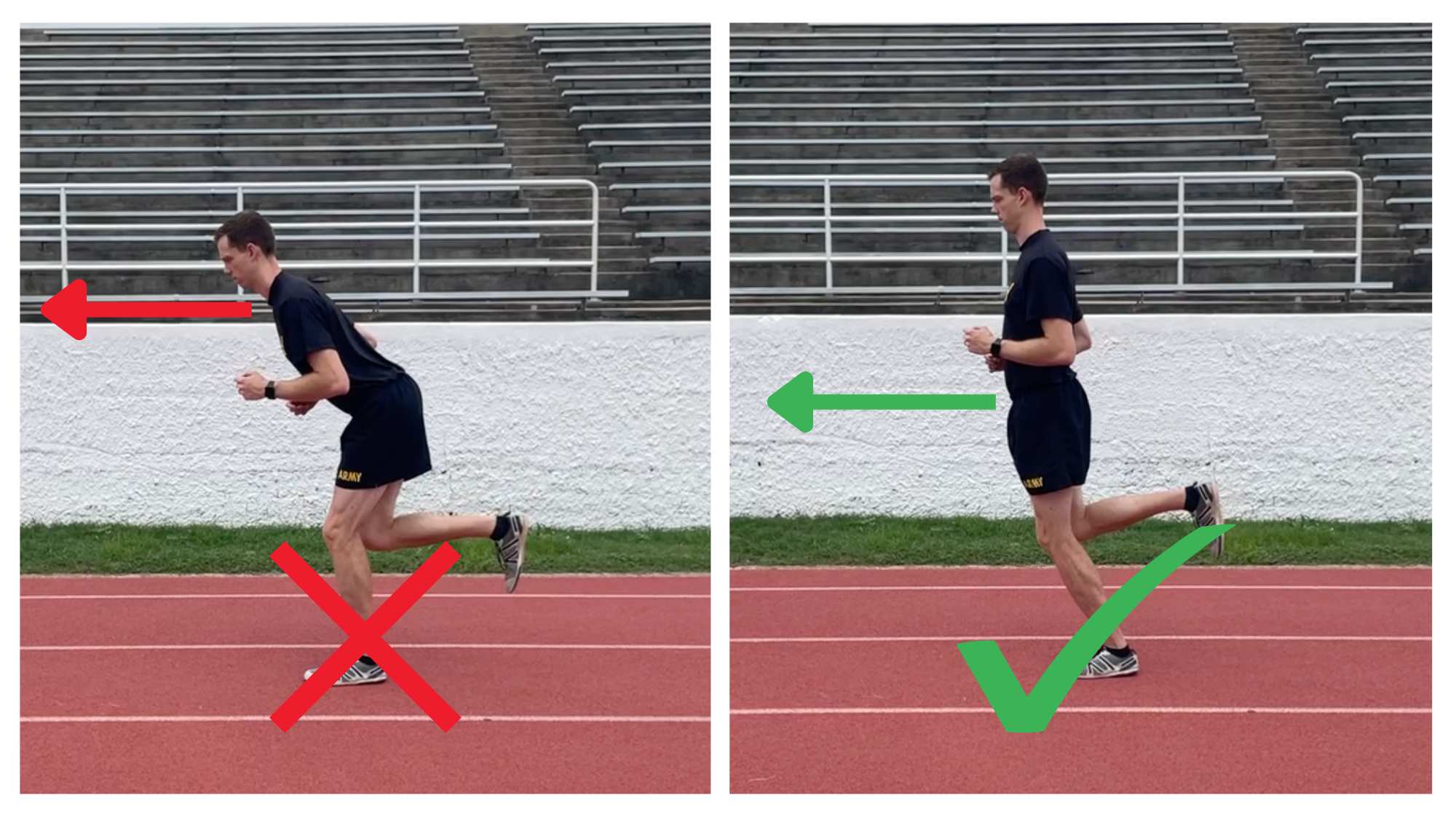
Gravitational pull is increased by shifting your center of mass forward. And when most people are told to "lean forward" when running they push their head forward and hips back, which results in no change in their center of mass.
"Falling forward at the hips" is the cue that's worked best for me to facilitate that forward shift in someone's center of mass.
Here's an example of "leaning forward" on the left and "falling forward at the hips" on the right.
If this principle is new to you, I highly recommend performing the below run drill so you can feel just how much gravity is able to pull you forward when running.
The drill is simple: Stand on one foot in a "running form" and repeatedly allow your hips to fall forward.
For this drill, it's important to keep your entire foot (heel included) on the ground for as long as you can. Don't lift the foot until your brain is screaming at you that you need to catch yourself. Push the limits. When you catch yourself it should feel a bit uncontrolled.
This is an "exaggeration drill", where the more you exaggerate proper run form (falling forward), the more carry over you'll feel in your run after.
A good way to program this drill is to perform around 5 falls per foot (alternating as you go) and on the last fall transition into a run.
As you settle into your run you won't feel anywhere near as much gravitational pull as you did in the drill, but you should still feel some.
If you don't feel that gravitational pull as you run, a good cue is to "squeeze your glutes" while running. This will force your hips forward, shifting your center of mass.
Conclusion
If you want to to reduce pain when running, reduce your risk of developing running-related arthritis, and improve your run performance, it's key to land with your foot as close to under your hips as possible.
There are two strategies to accomplish this:
1) Increase cadence
2) Fall forward at the hips
These two strategies alone account for 90% of what I work on with Advisors during individual run assessments and have helped dozens of my patients run pain-free and improve their run times.
It's simple, but it works.
Below is a catalog of additional considerations & answers to questions I'm frequently asked when hosting run clinics. I'd recommend reviewing them and coming back to this page as you work on optimizing your run form. As always, reach out to me if you have any questions.
Changing the way you run is something you have to fully commit to and practice regularly.
When practicing a new run form, I recommend running as often as your body & schedule allow (up to once a day), ensuring you stop your run if your form begins to break down.
➤ Cadence: Only increase your cadence by 5-10 steps per minute at a time. If you currently run at a cadence of 140, going straight to 180 will be too awkward. Instead, use a cadence of 145-150 until it feels natural (which may take a few weeks), and then progress another 5-10 steps per minute.
➤ Falling forward at the hips: Practice the repeated fall drill before each run as needed. In the early stages of run form optimization training it can be beneficial to perform the drill for ~10 reps, jog for 100 yards, perform the drill again, jog again, and repeat.
When you fix over-striding, the load that was being applied to your ankle, knee, hip, and low back joints still has to go somewhere. That somewhere is your Achilles tendon.
The Achilles tendon acts as a passive spring as you land, and the closer the foot lands under the hips, the more the Achilles tendon is loaded.
This is good because the Achilles, like any tendon, can grow and adapt. Joint cartilage on the other hand cannot "grow/adapt" - it can only stay the same or break down.
So just be cautious as you increase your mileage with your new run form. Respect your Achilles soreness and rest as needed so you don't strain your tendon - with time your Achilles will become stronger and the soreness will go away.
Yes and no.
If you take a group of 100 people who heel-strike and a group of 100 people who don't, the group of 100 people who heel-strike will have a higher incidence of pain & injury with running.
But, this is correlation, not causation. We know this because if you change nothing else about someone's run form other than their rear vs mid vs fore foot strike, their occurrence of pain/injury doesn't change.
The true issue is that over-striding is correlated with heel-striking.
If you take long strides, you'll almost always land with your heel first. On the other hand, an ideal stride length where your foot lands under your hips is correlated with midfoot & forefoot striking.
That's why when studies control for stride length, rear vs mid vs fore foot striking does not make a difference. It's the stride length that matters, not how your feet land.
What does this mean for you?
Relax your feet & ankles and allow them to react to the ground naturally.
All you should be considering is your cadence and where your hips are in space. If you think too hard about your foot strike you'll make your ankles stiffen up, which causes them to not be able to absorb the impact of the ground as well.
Just relax your feet and let them be.
The question of if there's a best type of running shoe has been studied extensively and the answer is definitive: there is no best running shoe.
Some people do great with a large stack height & heel drop, while others do best with a barefoot style shoe.
With that being said, barefoot shoes have a major benefit over high-stack shoes when you're working on improving your run form: barefoot shoes naturally limit over-striding.
If you over-stride when running on cement/asphalt in barefoot shoes your feet will immediately hurt. There just isn't enough cushion to absorb the blow. It won't prevent over-striding entirely, but it will make you notice it if you start slacking.
A low or zero heel drop will also make it easier for your foot to land under your hip. The bigger the heel drop, the sooner your foot will strike the ground as you pull your leg under you.
With all that being said, my personal recommendation is to run with as little support, cushion, and heel-drop as you can tolerate. Go to a shoe store and jog 100 yards with various styles of shoes. If you can handle 100 yards, you can slowly build up your tolerance for longer distances.
And when I say slowly, I mean slowly. It can take over a year to fully transition from a high-stack, high support, high heel-drop shoe to a barefoot shoe. For most people it's best to buy a few intermediate pairs of shoes as you progress to a barefoot style shoe.
Barefoot style shoes will expose your weaknesses, so only make the transition if you have time to also work on single leg stability training & improving your overall run form.
When most people first make the transition to a high cadence and hips forward run form, it makes running feel more difficult than before.
This causes some people to believe that making these changes will worsen their run time, which then leads to them thinking "well, I'm not willing to let my run time worsen, so I'll suck up the pain".
But the reality is that once your body gets used to high cadence & hips forward running, your run performance will improve.
Think of it as taking 1 step back so you can take 2 steps forward.
When you first break away from the running form you've been using your entire life there will be some inefficiencies.
But once you give it 6-8 weeks, your new run form will become more natural and running will feel even more effortless than before.
In addition to increasing cadence & falling forward at the hips, here's my next 3 most common running form optimization techniques/tips I recommend:
➤ Run with your shoulders relaxed: There should be a natural rise & fall of your shoulders as you jog. Don't overthink it, just relax your shoulders and breathe as feels natural.
➤ Use your hamstrings more: This is more of an advanced technique, but to faciliate a higher cadence you can actively pull with your hamstrings as your foot begins to leave the ground. Doing so will help your feet turnover quicker and make high cadence running feel easier.
➤ Buy new running shoes: Most people (myself included) go too long on a single pair of shoes. How long a pair of shoes lasts varies significantly, but as a general rule, if you think your shoes are starting to be a bit too worn down, they probably are.
For even more run drills, check out Chapter 7 of ATP 7-22.02. It's a fantastic resource for people who are serious about optimizing their run form.